Beyond the ISS: Building the next commercial LEO economy
The International Space Station opened the door to microgravity research. The next era will turn that foundation into a commercial LEO economy.
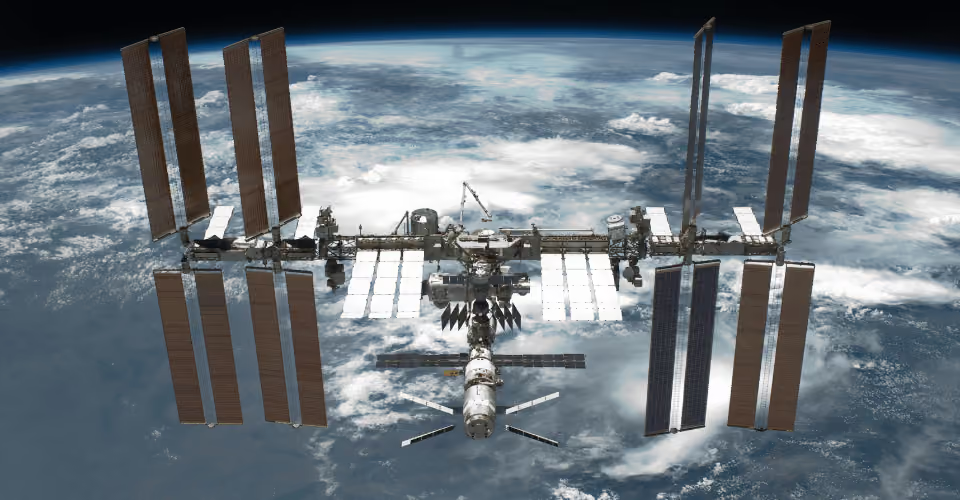
The International Space Station has transformed microgravity research. It established continuous human presence in orbit, enabled unprecedented international collaboration, and proved the value of orbital laboratories for science and technology development. Now, as its planned deorbit approaches, the question is no longer whether microgravity matters. It is what kind of LEO economy comes next.
The shift underway in LEO
Operations onboard the ISS have helped a diverse range of experiments and technologies mature from early concepts into commercially relevant systems. At the same time, the ISS has raised awareness of microgravity as a critical enabler for research, development, and manufacturing. That groundwork is now shaping a new LEO ecosystem with different demands:
• Highly frequent access to microgravity
• Increasing payload operator control over missions and timing
• New systems, technologies, and materials in use in orbit
• Growing sovereign access and control
These demands are different from what the ISS has provided for decades. They require new capabilities and new ways of operating in orbit. Rather than relying on a single, large, tightly regulated facility, the next LEO economy will be served by a mix of dedicated, scalable platforms that give research, commercial, and government users more control over their missions, timelines, and operating requirements.
Branching Out
As more organizations mature their microgravity capabilities, previously niche requirements are becoming large enough to support dedicated services. This branching out from standard ISS capabilities is already producing two complementary commercial solutions.
1. Commercial Crewed Space Stations
Typically referred to as Commercial LEO Destinations (CLDs) following the US-funded NASA program name. These space stations are owned and operated by commercial companies, providing services to NASA, ESA, and other customers including non-ISS governments and commercial users. These stations are large and are fully human-rated. Payloads onboard must not pose risks to the astronauts inhabiting the station, but can make use of the astronaut’s time and skills. Regular supply and return services are on the order of 4 – 12 missions per year per station. Examples include Starlab (international consortium), Haven-1 and -2 (Vast) and Axiom Station (Axiom).
2. Uncrewed Free-Flyers
Smaller, fully autonomous vehicles with their own standalone re-entry capability allow a wider range of payloads onboard as they are not human-rated. Shorter and higher cadence missions are also possible, as well as custom integrations and operations. Without crew onboard, payloads need to operate autonomously, but have none of the concerns of human-rated risk. This is where Outlier’s vehicles operate.
Higher cadence free-flyers can support the scale required for regular manufacturing missions; while many research and development missions still require human intervention to complex, irregular activities.
What the next LEO economy needs
As the ISS moves toward decommissioning, the next five years will accelerate the transition to commercial LEO infrastructure. CLDs currently attract much of the attention, but uncrewed free-flyers are increasingly recognized as a critical part of the market. Their value is straightforward: high-cadence access, custom mission design, and lower operational complexity for the business models needed to kick-start the LEO manufacturing revolution.
If you'd like more insights, connect with our team.